The allure of the unexplained has long captivated the human imagination, and among the most enduring mysteries are those surrounding Unidentified Flying Objects. For decades, alleged UFO sightings have been documented, often accompanied by photographic or video evidence. However, the journey from an original recording to the myriad copies that proliferate online and in popular culture is fraught with potential distortions, intentional or otherwise. Understanding the key differences between original UFO footage and its subsequent copies is crucial for anyone seeking to analyze these phenomena critically. This article will delve into the multifaceted aspects that differentiate authentic recordings from their proliferated descendants, examining the technical, contextual, and interpretative elements at play.
The Tangible Differences: Signal Integrity and Artifacts
The most fundamental distinctions between original and copied UFO footage lie in their technical fidelity. A true original recording possesses a direct link to the event it purports to capture, free from the degradation that inevitably occurs with each generation of duplication. Conversely, copies are inherently compromised, bearing the scars of their lineage.
Raw Data vs. Compressed Streams
Original footage, especially from professional or semi-professional recording devices, often exists in a less processed, more data-rich format. This could be raw camera sensor data, uncompressed video files, or high-bitrate recordings. These formats retain the maximum amount of visual information, including subtle details, gradations of light, and a wider dynamic range. When analyzing such footage, investigators can often glean more precise information about the object’s texture, reflectivity, and movement.
Copied footage, on the other hand, is frequently subjected to compression algorithms to reduce file size for easier storage and transmission. Formats like MP4, AVI, or MOV, commonly found online, utilize lossy compression, meaning that some data is discarded to achieve smaller file sizes. This process can introduce visible artifacts, such as blockiness, banding, pixelation, and a reduction in sharpness. While these artifacts might not always obscure the central subject, they can mask crucial details or create misinterpretations, especially in low-light conditions or during rapid movement. The difference is akin to examining a high-resolution photograph versus a thumbnail image – the former offers immense detail, while the latter provides a general impression.
Generation Loss: The Cumulative Effect of Duplication
Every time analog or digital video is copied, there is a potential for loss of quality. This phenomenon, known as generation loss, is more pronounced in analog formats but still affects digital recordings, albeit in different ways. For analog sources like VHS tapes, each copy results in a tangible degradation of image clarity, color saturation, and introduction of noise or static. Digital copies, while not suffering the same kind of analog decay, can still lose fidelity through re-encoding, format conversion, or simply being saved multiple times in different formats.
When examining a piece of alleged UFO footage, discerning its original form often involves looking for telltale signs of generation loss. Original recordings, by definition, have experienced zero generation loss from the initial capture. Even a first-generation copy will be superior to a third or fourth-generation duplicate. Observers might notice a lack of crispness, a muted color palette, or the presence of digital noise that seems to be uniformly distributed, indicative of repeated processing rather than genuine environmental conditions.
Audio Integrity: A Crucial but Often Overlooked Element
The audio track accompanying video footage is just as important as the visual component, and it, too, is susceptible to degradation through copying. Original recordings typically possess the clearest, most unadulterated audio captured at the scene. This can include ambient sounds, witness narration, or any unusual noises associated with the object itself.
Copies, particularly those that have been through multiple transfers or edited extensively, can suffer from reduced audio quality. This might manifest as muffled speech, introduction of hiss or hum, or a loss of dynamic range, making it harder to discern subtle auditory cues. In the context of UFO sightings, the audio can provide invaluable clues, such as whether the object emitted any sound or if witness descriptions align with audible phenomena. A degraded audio track in a copied version can obscure these crucial details, leading to a less informed analysis.
In recent discussions surrounding the authenticity of UFO footage, the differences between original copies and edited versions have become a focal point for researchers and enthusiasts alike. A related article that delves deeper into this topic can be found at Unplugged Psych, where the nuances of video manipulation and the implications for public perception are thoroughly examined. This exploration not only highlights the importance of verifying sources but also raises questions about the impact of media on our understanding of unidentified aerial phenomena.
Contextual Clues: Provenance and Authenticity
Beyond the purely technical aspects, the context surrounding a piece of footage is paramount in assessing its potential authenticity. The origin story, the circumstances of its capture, and the chain of custody all contribute to our understanding of whether we are looking at an original recording or a carefully constructed fabrication.
The Witness and the Recording Device
The credibility of the individual who captured the footage and the nature of the recording device are primary considerations. An original UFO sighting is typically reported by a witness who has provided a detailed account of their experience, including the time, location, and duration of the observation. If this witness also claims to have recorded the event, their background, reputation, and any potential biases become relevant.
The recording device itself is another critical factor. Was it a high-definition smartphone, a professional video camera, a military-grade sensor, or a simple disposable camera? The capabilities of the device at the time of recording will dictate the quality and type of footage that could have been captured. For instance, a grainy, low-resolution video from a flip phone is unlikely to be an original capture of a highly detailed aerial phenomenon if the technology of the time couldn’t support such clarity. Conversely, an original recording from advanced military or scientific equipment would carry more weight due to the specialized nature of the recording and the expertise of the operators.
Chain of Custody: Tracing the Footprints of Evidence
For any piece of evidence, including video footage, a well-documented chain of custody is essential for establishing its integrity. An original recording should ideally have a clear, unbroken line of provenance, detailing who possessed the footage, when, and how it was transferred. This might involve original media (e.g., SD cards, hard drives), logbooks, or official documentation.
Copies, by their nature, disrupt this chain. They are often shared informally, uploaded to public platforms without verification, or passed around within communities. When attempting to trace the origin of a piece of alleged UFO footage, investigators will look for a traceable lineage. The absence of such a chain, or a history of frequent, unverified transfers, raises red flags. It suggests that the footage may have been manipulated, re-edited, or even fabricated at some point along its journey. The more difficult it is to establish the provenance of a recording, the less likely it is to be considered an authentic original.
Documentation and Metadata: The Silent Witnesses
Original recordings often come with associated metadata – embedded information that provides details about the capture itself. This can include the date and time of recording, the camera model, GPS coordinates, and even camera settings. This metadata acts as a silent witness, offering verifiable information about the context of the recording.
Copied footage, especially when re-encoded or transferred through various platforms, can lose or have its metadata altered. Platforms like YouTube, for instance, strip much of the original metadata and replace it with their own. If a piece of footage claims to be an original but lacks any verifiable metadata, or if the metadata appears inconsistent with the purported recording circumstances, it warrants suspicion. Conversely, the presence of robust, consistent metadata that aligns with the witness’s account can lend credence to the claim of an original recording.
The Specter of Manipulation: Digital Alteration and Deception

In the digital age, the line between authentic footage and fabricated content has become increasingly blurred. Advances in video editing software allow for sophisticated manipulation, making it possible to insert objects, alter environments, or entirely create scenes that never occurred. This is a significant concern when dealing with alleged UFO footage, as the potential for deception is immense.
Deepfakes and CGI: The Art of Visual Illusion
Modern digital tools have made the creation of convincing artificial imagery commonplace. Computer-generated imagery (CGI) can be used to generate realistic-looking objects and phenomena that can be seamlessly integrated into existing footage. Deepfake technology, which uses artificial intelligence to superimpose one person’s likeness onto another’s body, can also be applied to creating fabricated events.
Original UFO footage, by definition, would not contain elements created through CGI or deepfake technology. The challenge lies in identifying these artificial elements within a copied or manipulated recording. This requires a keen eye for inconsistencies in lighting, shadows, motion, texture, and reflections. For instance, a CGI object might cast shadows that don’t align with the environmental light sources, or its movement might appear too perfect or too unnatural. The more sophisticated the manipulation, the more difficult it becomes for the untrained eye to detect, underscoring the need for expert analysis.
Editing and Recontextualization: Subtle Shifts in Narrative
Even without outright fabrication, editing can significantly alter the perception of footage. Footage that might have captured a mundane aerial phenomenon – a drone, a weather balloon, or even a conventional aircraft under unusual lighting conditions – can be edited to appear more mysterious. This might involve speeding up or slowing down footage, cropping it to remove contextual clues, or juxtaposing it with dramatic music and narration.
Original footage, in its unedited form, presents the raw visual information as captured. Copies that have undergone such editing might exhibit abrupt cuts, unnatural transitions, or a narrative flow that seems designed to provoke a specific emotional response rather than present objective evidence. The removal of surrounding context – such as other objects in the sky, the environment, or the duration of the sighting – can transform an ordinary event into something seemingly extraordinary. Investigators will look for evidence of such selective editing or recontextualization to understand if the footage is being presented in its original, unaltered state.
Intentional Hoaxes and Pranks: The Human Element of Deception
Not all manipulated footage is created with advanced technology; some hoaxes are born from simpler intentions, such as pranks or a desire for attention. Individuals might use readily available objects, such as balloons, drones, or even household items, to create a fleeting impression of something unusual. These hoaxes, when recorded and subsequently copied, can contribute to the proliferation of misinformation.
Distinguishing these deliberate deceptions from genuine sightings often comes down to a combination of technical analysis and contextual understanding. A seemingly “UFO” that behaves in a predictable, easily explainable manner, or whose appearance is consistent with common, albeit unusual, man-made objects, might be the result of a prank. The key is to consider the simplest explanation that fits the evidence, rather than immediately jumping to extraordinary conclusions. Original footage from a hoax would still be a recording of a fabricated event, but the lack of sophisticated manipulation might make it easier to identify the underlying deception through logical deduction and knowledge of common objects and phenomena.
The Role of Interpretation: Perception vs. Reality
Even when dealing with potentially original footage, the interpretation of what is being seen is subjective and prone to bias. What one person perceives as an anomalous craft, another might see as a familiar object under unusual circumstances. This is where the distinction between original footage and its copied, and often narratively framed, successors becomes particularly important.
Subjectivity and Expectation Bias: Seeing What We Want to See
Human perception is not a perfect recording device. Our brains are constantly interpreting sensory input, and these interpretations are influenced by our prior experiences, beliefs, and expectations. In the context of UFOs, a strong belief in extraterrestrial visitation can lead individuals to interpret ambiguous visual data in a way that confirms their pre-existing notions.
Original footage, when viewed with a critical and objective mindset, allows for a more direct engagement with the visual evidence. However, even with an original recording, subjective interpretation remains a factor. When the footage is copied and disseminated with accompanying narratives or sensationalized headlines, these external interpretations can heavily influence how viewers perceive the object. The original footage itself might be ambiguous, but the way it is presented in copies can steer viewers towards a predetermined conclusion, obscuring the actual ambiguity of the phenomenon.
The Power of Narrative: Shaping Perceptions Through Storytelling
Copied UFO footage is rarely presented in a vacuum. It is often accompanied by stories, testimonials, and explanations that frame the visual information in a particular way. These narratives can be highly persuasive, imbuing the footage with a sense of mystery, threat, or wonder that might not be inherent in the original recording.
Original footage, if it exists in an unadulterated, uncontextualized form, allows for a more independent analysis. The viewer is left to form their own conclusions based solely on the visual and auditory data. Copies, however, often come pre-packaged with a narrative that guides interpretation. This can be a powerful tool for both genuine enthusiasts seeking to share their findings and for those who wish to mislead. The story surrounding the footage can be just as influential, if not more so, than the footage itself in shaping public perception.
Expert Analysis vs. Popular Opinion: Navigating the Discourse
The discourse surrounding UFO footage is often divided between rigorous expert analysis and popular opinion, which is heavily influenced by media portrayals and online discussions. Experts, such as astrophysicists, engineers, and aviation specialists, approach footage with a scientific methodology, seeking empirical evidence and plausible explanations. Popular opinion, on the other hand, can be more speculative and driven by emotional responses.
Original footage, when presented to experts for analysis, is subject to scrutiny based on established scientific principles and observational data. The findings of these experts can then be compared to the interpretations that emerge from the popular dissemination of copied footage. Often, the sensationalized narratives accompanying copied videos can diverge significantly from the more measured conclusions of scientific investigation. Understanding this distinction is crucial for separating genuine attempts to understand the unknown from the propagation of unsubstantiated claims.
In recent discussions about the authenticity of UFO sightings, the differences between original footage and edited versions have become a focal point for enthusiasts and skeptics alike. A related article that delves into this topic can be found on Unplugged Psych, where it explores how alterations in video quality and presentation can significantly impact public perception of UFO evidence. For more insights, you can check out the article here. Understanding these nuances is crucial for anyone interested in the ongoing debate surrounding unidentified aerial phenomena.
Conclusion: The Pursuit of Clarity in a Sea of Information
| Aspect | Original UFO Footage | Copy of UFO Footage | Difference |
|---|---|---|---|
| Resolution | 1920×1080 pixels | 1280×720 pixels | Lower resolution in copy, loss of detail |
| Frame Rate | 30 fps | 24 fps | Reduced smoothness in motion |
| Color Accuracy | True color spectrum | Faded colors, slight color shift | Color degradation and distortion |
| File Format | RAW video (.mov) | Compressed video (.mp4) | Compression artifacts introduced |
| Audio Quality | Original ambient sound | Audio with background noise | Loss of clarity and added noise |
| Metadata | Complete metadata (date, time, location) | Partial or missing metadata | Loss of contextual information |
| Authenticity Indicators | Original timestamps and camera data | Altered or missing timestamps | Potential questions on authenticity |
The proliferation of UFO footage, while offering a vast repository of visual data, presents a significant challenge in separating the wheat from the chaff. The journey from an original recording to countless copies is a process that can introduce technical degradation, facilitate manipulation, and influence interpretation. By understanding the key differences between original and copied footage – from signal integrity and artifacts to provenance and the impact of narrative – individuals can approach this complex subject with a more discerning and critical eye.
The pursuit of clarity in the realm of UFO phenomena necessitates a commitment to rigorous analysis, a healthy skepticism towards sensationalism, and an appreciation for the technical and contextual factors that shape our understanding of visual evidence. While the allure of the unknown will undoubtedly continue to draw attention to alleged UFO sightings, a mindful approach to the origin and fidelity of the footage is essential for anyone seeking to navigate the ever-expanding sea of information and inch closer to the truth, whatever it may be. The original recording, however imperfect, often holds the most unvarnished truth, while its copies, though numerous, can become increasingly distorted reflections of that initial reality.
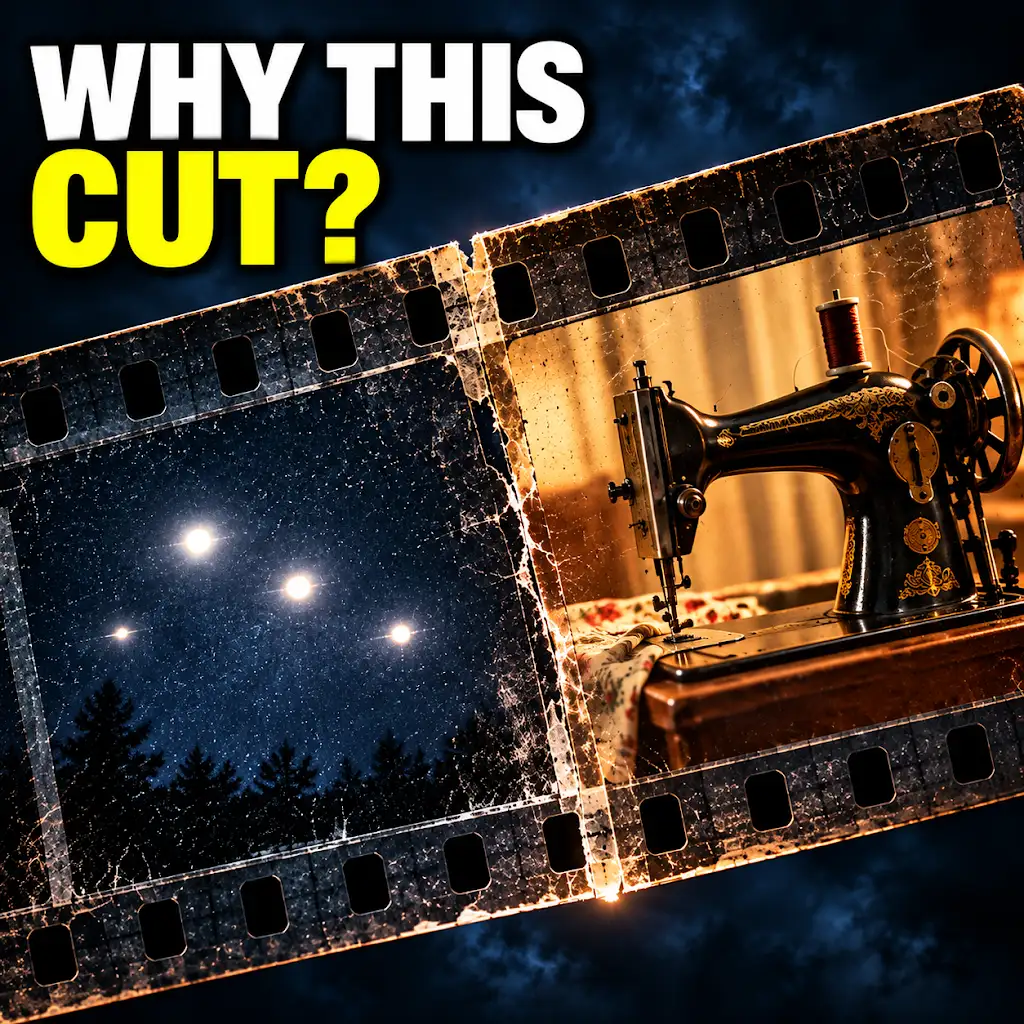
The Pentagon’s 1952 UFO Film Cuts to a Sewing Machine
FAQs
What is the difference between UFO footage and its original copy?
The original copy of UFO footage refers to the raw, unedited video or image captured by the person who witnessed the unidentified flying object. UFO footage, on the other hand, may have been edited, enhanced, or altered in some way before being shared with the public.
Why is it important to distinguish between UFO footage and its original copy?
Distinguishing between UFO footage and its original copy is crucial for verifying the authenticity of the content. The original copy provides a baseline for comparison and helps determine if any manipulation or tampering has occurred.
How can one identify alterations in UFO footage compared to the original copy?
Altered UFO footage may show signs of editing such as added visual effects, changes in lighting or color, or inconsistencies in the object’s movements. By comparing it to the original copy, discrepancies can be identified more easily.
Are there any common reasons why UFO footage may be altered before being shared?
UFO footage may be altered for various reasons, including enhancing the visual quality, adding dramatic effects for entertainment purposes, or attempting to deceive viewers by fabricating evidence of extraterrestrial activity.
What precautions should be taken when analyzing UFO footage and its original copy?
When analyzing UFO footage and its original copy, it is important to use reliable software tools for forensic analysis, consult experts in image and video authentication, and consider the credibility of the source that shared the footage.