You’re lying in bed, the day’s worries beginning to recede, but instead of sleep’s gentle embrace, a knot tightens in your chest. The darkness presses in, amplifying every whisper of doubt, every fleeting fear. You know this feeling intimately – the peculiar way nighttime anxiety seems to possess a darker, more potent flavor than its daytime counterpart. It’s a common, yet often isolating, experience. But why does the absence of light seem to ignite such a potent cocktail of dread? It’s not merely a trick of the mind; the impact of darkness on your anxious state is deeply rooted in a complex interplay of biology, psychology, and environmental factors.
Your body, a marvel of intricate biological machinery, operates on an internal clock known as the circadian rhythm. This rhythm, influenced by light and darkness, dictates a vast array of physiological processes, including your sleep-wake cycle, hormone production, and even your mood. When darkness descends, your body naturally begins to prepare for rest. The pineal gland, a tiny endocrine gland located in the brain, starts releasing melatonin, the sleep hormone. While this is a crucial signal for sleep, it also has a profound effect on your brain’s activity.
Melatonin: More Than Just a Sleep Aid
You might think of melatonin solely as the key that unlocks sleep, but its influence extends far beyond that. Melatonin is also a potent antioxidant and plays a role in regulating the immune system. However, critically for your nighttime anxiety, melatonin also has neuromodulatory effects. Studies suggest that elevated levels of melatonin can alter the sensitivity of certain neurotransmitter receptors in your brain, including those associated with serotonin and dopamine. These neurotransmitters are directly involved in regulating mood, anxiety, and stress responses.
The Shift in Neurotransmitter Balance
During the day, your brain is awash with light, which helps to suppress melatonin production and, in turn, influences the balance of these mood-regulating neurotransmitters. Your amygdala, the brain’s fear center, is generally more regulated. However, as darkness deepens and melatonin levels rise, this delicate balance can shift. For some individuals prone to anxiety, this shift can lead to a heightened state of arousal. The reduced inhibitory control that might be present during daylight hours can diminish, making you more susceptible to feeling overwhelmed by anxious thoughts. It’s as if the natural dampening effect of daylight is removed, leaving your emotional response more exposed.
Cortisol and the Stress Hormone’s Nocturnal Rise
Adding another layer to this biological cocktail is cortisol, often referred to as the stress hormone. While cortisol levels typically dip in the evening and are lowest around midnight, they begin to rise in the early morning hours to help you wake up. However, for individuals experiencing chronic stress or anxiety, this pattern can be disrupted. In some cases, cortisol levels may remain elevated throughout the night, contributing to a heightened sense of alertness and vigilance, which is the antithesis of restful sleep and can fuel anxiety. This persistent elevation of cortisol, coupled with the effects of melatonin, creates a biological environment that is ripe for anxiety to flourish.
Nighttime anxiety often feels more intense due to the quiet and solitude that accompany the late hours, allowing intrusive thoughts to surface more readily. In an insightful article on this topic, the author explores the psychological mechanisms behind nighttime anxiety and offers practical strategies for managing it. For more information, you can read the article here: Unplugged Psych.
The Psychological Landscape of Darkness
Beyond the biological underpinnings, the psychological impact of darkness on your anxious mind is significant. Darkness inherently strips away visual cues, forcing your mind to fill in the blanks. When you’re already anxious, your mind is prone to conjuring worst-case scenarios, and the void created by darkness provides fertile ground for these fears to take root and grow.
The Loss of Visual Anchors
During the day, your surroundings provide a constant stream of information. You can see familiar objects, recognize your environment, and gain a sense of control through your visual perception. The light allows you to ground yourself in reality. As darkness descends, these visual anchors disappear. The room that feels comforting by day can transform into a shadowy expanse, where the ordinary can become menacing. The subtle creak of the house, the rustle of leaves outside your window – sounds that might go unnoticed in daylight can become amplified and interpreted as threats in the absence of visual reassurance.
The Mind’s Tendency to Embellish
Your brain is wired to seek patterns and make sense of its environment. In the absence of clear visual input, especially when you’re feeling anxious, your brain can engage in a process of imaginative embellishment. It tries to fill the void, and unfortunately, when anxiety is present, these embellishments often lean towards the negative. A shadow might morph into a lurking figure, a familiar object might take on an unsettling form, and even the silence can feel heavy with unspoken dread. This self-generated internal narrative, fueled by the lack of external stimuli, can be a powerful driver of nighttime anxiety.
The Amplification of Internal Monologue
During the day, you’re often engaged in a multitude of activities and social interactions that serve as distractions from your internal thoughts. These external engagements can act as a buffer against persistent anxious rumination. However, at night, with fewer distractions available, your internal monologue takes center stage. The thoughts that you might have managed to push aside during the day can resurface with renewed vigor. Darkness provides a quiet, uninterrupted space for these worries to fester and grow, creating a self-perpetuating cycle of anxious thinking.
The Fear of the Unknown and the Loss of Control

Darkness is intrinsically linked to the unknown. It’s the absence of light, and therefore, the absence of information. For humans, this innate uncertainty can be a source of primal fear. When you’re already struggling with anxiety, this feeling of not knowing what lurks in the darkness, or what might happen next, can be particularly unsettling and exacerbate your feelings of losing control.
The Primal Instinct for Vigilance
Throughout human evolution, alertness during darkness was a matter of survival. Predators were more active, and visibility was limited, making individuals vulnerable. This primal instinct for vigilance, while largely unnecessary in modern, safe environments, can still be triggered by the darkness. Your body’s ancient alarm system might be subtly activated, leading to a state of hyperarousal and a heightened sense of danger, even when there’s no tangible threat. This is why you might find yourself scanning the room, listening intently for any unusual sounds, feeling a sense of unease that you can’t quite pinpoint.
The Erosion of Perceived Safety
Your home, during the day, is typically a sanctuary – a place of safety and comfort. However, when darkness falls, this perception can be subtly eroded. The familiar becomes unfamiliar, and the security you felt during daylight hours can begin to dissipate. This loss of perceived safety can be a significant contributor to nighttime anxiety, as it undermines your feeling of being secure and protected. The lack of visual confirmation of your surroundings can lead to a feeling that the usual boundaries of safety have dissolved.
The Struggle for Control in an Unseen World
Anxiety is often characterized by a feeling of a loss of control. During the day, you have agency over your environment to a certain extent. You can interact with the world, make decisions, and see the immediate consequences of your actions. In the darkness, this sense of agency is diminished. You are more reliant on your other senses, and the inability to fully perceive and control your surroundings can intensify feelings of helplessness and vulnerability, feeding directly into your anxious state.
The Impact of Sensory Deprivation and Overstimulation
While darkness might seem like a form of sensory deprivation, it can paradoxically lead to sensory overstimulation in the anxious mind. When your visual input is limited, your other senses can become heightened, and this can be a double-edged sword.
Heightened Auditory Sensitivity
In the quiet of the night, sounds that you might easily filter out during the day can become amplified. The hum of the refrigerator, the ticking of a clock, or even the distant sounds of traffic can seem unusually loud and intrusive. For someone experiencing anxiety, these heightened auditory stimuli can be perceived as threatening or unsettling, further contributing to a feeling of being on edge. Your brain, seeking information, latches onto these sounds, and in its anxious state, may interpret them as signals of danger.
The Tactile and Olfactory Sensations
Even subtle tactile sensations, like the feeling of your sheets against your skin or the weight of your blanket, can become more pronounced in the darkness. Similarly, any ambient odors in your room might seem more noticeable. While these sensations are usually innocuous, when coupled with an anxious mindset, they can be interpreted in negative ways. A slightly cool draft might feel like an impending presence, or a faint musty smell could trigger thoughts of decay or neglect. Your brain, deprived of visual input, is more likely to focus on and potentially misinterpret these other sensory experiences.
The Internal Physical Sensations
Perhaps the most insidious form of overstimulation in the dark is the amplification of your own internal physical sensations. The subtle thump of your heart, the slight ache in your shoulder, the flutter in your stomach – these bodily sensations are always present, but in the quiet of the night, without external distractions, they can become magnified. When you’re anxious, these normal bodily sensations can be misconstrued as symptoms of illness or impending doom, creating a feedback loop of worry and physical discomfort.
Many individuals experience heightened feelings of anxiety during the nighttime, which can be attributed to various factors such as the quiet environment and lack of distractions. This phenomenon is explored in depth in a related article that discusses the psychological mechanisms behind nighttime anxiety and offers coping strategies. For more insights, you can read the article here. Understanding these triggers can help individuals manage their anxiety more effectively and find peace during the night.
The Vicious Cycle: Darkness, Anxiety, and Sleep Disruption
| Reasons | Explanation |
|---|---|
| Quiet environment | During nighttime, the surroundings are usually quieter, making it easier to focus on anxious thoughts. |
| Alone with thoughts | Being alone in bed can lead to overthinking and ruminating on worries, making anxiety feel more intense. |
| Lack of distractions | There are fewer distractions at night, which can amplify anxious feelings and make them harder to ignore. |
| Physical sensations | Physical symptoms of anxiety, such as racing heart or shallow breathing, may feel more pronounced in the stillness of the night. |
The relationship between nighttime anxiety and darkness is not a one-way street. It’s a cyclical and often vicious one, where each element exacerbates the other, leading to significant sleep disruption.
The Anticipatory Anxiety of Nightfall
For many who experience nighttime anxiety, the mere anticipation of darkness can trigger a cascade of worries. As the sun begins to set, a sense of dread can start to creep in, knowing that the challenges of the night lie ahead. This anticipatory anxiety can lead to a state of hypervigilance even before you’ve gone to bed, making it incredibly difficult to wind down and relax. The fear of the anxiety itself becomes a source of anxiety.
The Struggle to Initiate Sleep
When your mind is racing with anxious thoughts, the transition into sleep becomes a battle. The very act of trying to fall asleep, when your body is in a state of arousal, can be incredibly frustrating. This frustration can further fuel your anxiety, creating a Catch-22 situation. You want to sleep, but your anxiety prevents it, and the inability to sleep makes your anxiety worse. Darkness, which should be conducive to sleep, becomes a stage for your anxiety to play out.
The Fragmented and Restless Sleep
Even if you manage to drift off, the sleep you experience at night when battling anxiety is often fragmented and restless. You might wake up frequently, jolted by anxious thoughts or physical discomfort. This lack of restorative sleep can leave you feeling exhausted and irritable the next day, perpetuating the cycle. Poor sleep quality can lower your resilience to stress, making you more susceptible to anxiety the following night. The darkness that should bring rest becomes a source of disruption.
The Day-Night Reversal of Anxiety
Ironically, for some, the anxiety that is most potent at night can feel almost absent during the day. The busyness of daily life, the social interactions, and the bright light can provide enough distraction and grounding to keep the anxieties at bay. However, as the external world quiets down and the light fades, these suppressed worries can resurface with a vengeance, making nighttime anxiety a particularly challenging aspect of living with an anxiety disorder. This stark contrast can be disorienting and contribute to feelings of isolation, as you might not fully understand why the same thoughts feel so manageable at 2 PM but so overwhelming at 2 AM. The darkness, by stripping away the day’s defenses, reveals the depth of your internal struggles.
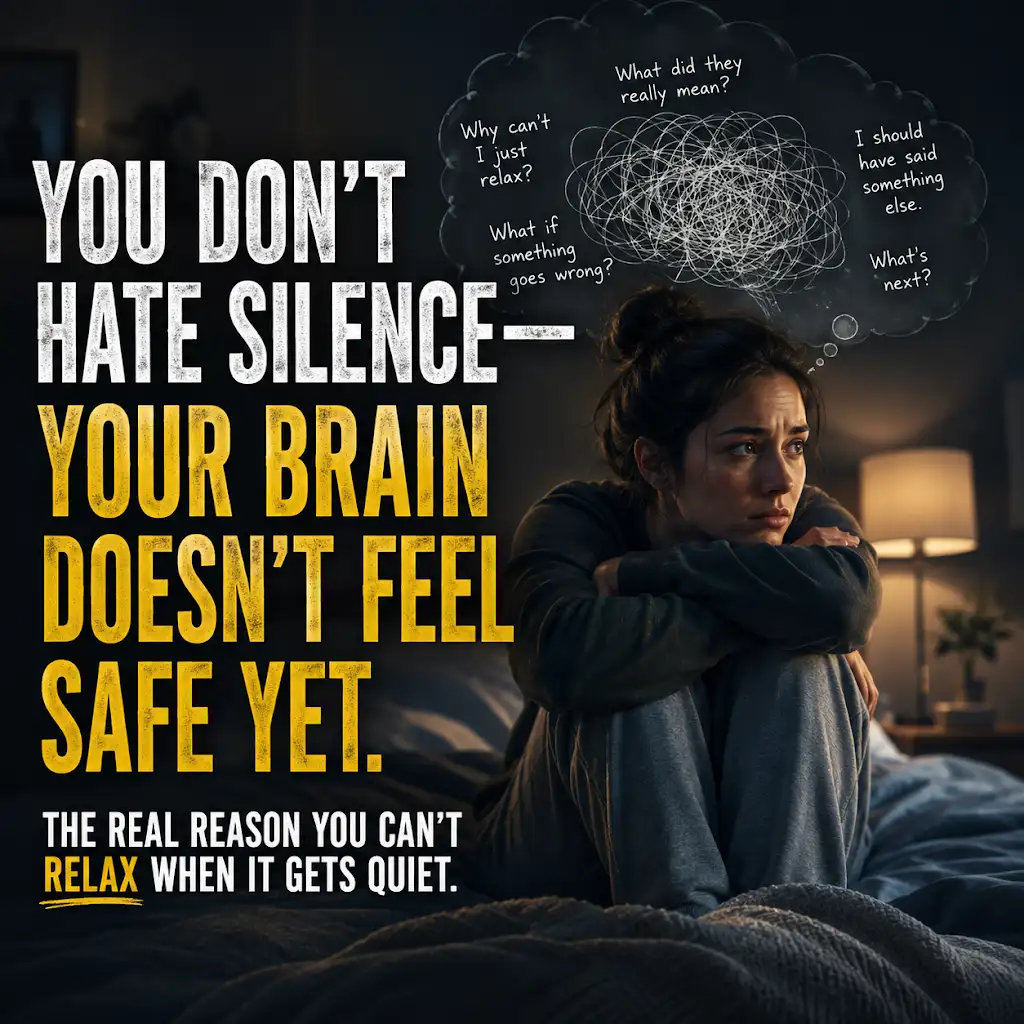
You Don’t Hate Silence—Your Brain Doesn’t Feel Safe Yet
FAQs
What is nighttime anxiety?
Nighttime anxiety refers to feelings of worry, fear, or unease that are particularly intense or distressing during the evening or when trying to fall asleep. It can manifest as racing thoughts, physical symptoms like rapid heartbeat or sweating, and difficulty relaxing or calming the mind.
Why does nighttime anxiety feel worse?
Nighttime anxiety can feel worse for several reasons. Firstly, the quiet and stillness of the night can make it easier to focus on anxious thoughts. Additionally, the lack of distractions and the anticipation of being alone with one’s thoughts can exacerbate feelings of anxiety. Hormonal changes and disruptions in the body’s natural rhythms during the night can also contribute to heightened anxiety.
How does nighttime anxiety affect sleep?
Nighttime anxiety can significantly impact sleep quality and duration. Individuals experiencing nighttime anxiety may have difficulty falling asleep, staying asleep, or experiencing restful sleep. This can lead to fatigue, irritability, and difficulty functioning during the day.
What are some strategies for managing nighttime anxiety?
Some strategies for managing nighttime anxiety include practicing relaxation techniques such as deep breathing or progressive muscle relaxation, creating a calming bedtime routine, limiting screen time before bed, and seeking professional help if the anxiety is persistent or severe. Cognitive-behavioral therapy and medication may also be effective treatments for nighttime anxiety.
When should someone seek professional help for nighttime anxiety?
If nighttime anxiety is significantly impacting daily functioning, causing distress, or interfering with sleep on a regular basis, it may be beneficial to seek professional help. A mental health professional can provide an accurate diagnosis, offer personalized treatment options, and support individuals in managing their nighttime anxiety.