The Watson and Rayner Experiment: Conditioning Behavior
The early 20th century was a fertile ground for groundbreaking psychological inquiry. Among the most provocative and enduring studies of this era stands the Watson and Rayner experiment, a powerful demonstration of classical conditioning applied to human behavior. Conducted by John B. Watson and his graduate student Rosalie Rayner in 1920 at Johns Hopkins University, this experiment aimed to prove that fear, a seemingly innate emotion, could be conditioned in humans. While controversial from its inception and fraught with ethical concerns by modern standards, the “Little Albert” experiment, as it became known, provided compelling evidence for the power of association in shaping emotional responses, fundamentally influencing the field of behaviorism.
Watson’s Vision: Psychology as a Science of Behavior
John B. Watson, a pivotal figure in the development of behaviorism, harbored a fervent desire to elevate psychology from what he perceived as its introspective and subjective roots to the status of a truly objective science. He was deeply influenced by Ivan Pavlov’s work on classical conditioning in dogs, observing how a neutral stimulus could elicit a response when repeatedly paired with an unconditioned stimulus that naturally produced that response. Watson believed that all human behavior, including emotions and complex thought processes, could be explained and predicted through the principles of stimulus-response relationships. He famously declared, “Give me a dozen healthy infants, well-formed, and my own specified world to bring them up in, and I’ll guarantee to take any one at random and train him to become any type of specialist I might select – doctor, lawyer, artist, merchant-chief, and, yes, even beggar-man and thief, regardless of his talents, penchants, tendencies, abilities, vocations, and race of his ancestors.” This bold assertion underscored his unwavering faith in the power of environmental conditioning.
The Role of Emotion: An Uncharted Territory
While behaviorism had begun to explore observable actions and their environmental triggers, the realm of human emotion remained a significant challenge. Watson argued that emotions, like all other behaviors, were learned responses to specific stimuli. He posited that infants were born with only a few innate emotional responses, primarily fear, rage, and love. He believed that other, more complex emotions developed through the process of association. The Watson and Rayner experiment was designed to empirically test this hypothesis, specifically focusing on the conditioning of fear.
Ethical Considerations: A Shadow Over the Experiment
It is crucial to acknowledge, from the outset, that the Watson and Rayner experiment is deeply problematic from an ethical standpoint. The use of an infant as a subject, the deliberate induction of fear, and the lack of informed consent from the child’s caregivers (beyond a questionable agreement that he would be removed from the hospital if they were dissatisfied) represent significant ethical violations by today’s standards. The experiment’s lasting impact on Little Albert, who was removed from the hospital before any unconditioning could be attempted, remains a stark reminder of the potential for psychological harm in research.
The Watson and Rayner experiment, famously known for its investigation into classical conditioning through the case of Little Albert, has been a pivotal study in understanding emotional responses and behaviorism. For a deeper exploration of this experiment and its implications in psychology, you can refer to a related article that delves into the methodologies and ethical considerations surrounding such studies. To read more, visit this article.
The Subject: Little Albert and His Environment
Identifying the Unconditioned Stimulus
The researchers selected an infant, later identified as Albert B. (though his full identity and subsequent fate remain subjects of historical debate), who was approximately nine months old at the time of the initial stages of the experiment. Albert was described as generally healthy and healthy and exhibiting no prior signs of fear towards the stimuli that would later become conditioned. This lack of pre-existing fear was essential for the experiment’s design, as it allowed Watson and Rayner to isolate the effects of conditioning.
The Unconditioned Stimulus: The Loud Noise
The unconditioned stimulus (UCS) chosen to elicit the fear response was a loud, sudden noise. This stimulus was selected because it was believed to be inherently fear-inducing in infants, a response that did not require prior learning. In practice, Watson and Rayner would strike a steel bar with a hammer behind Albert while he was being presented with the experimental stimuli. This produced a startling and unpleasant sound that invariably caused Albert to cry, show fear, and physically recoil.
The Neutral Stimulus: The White Rat
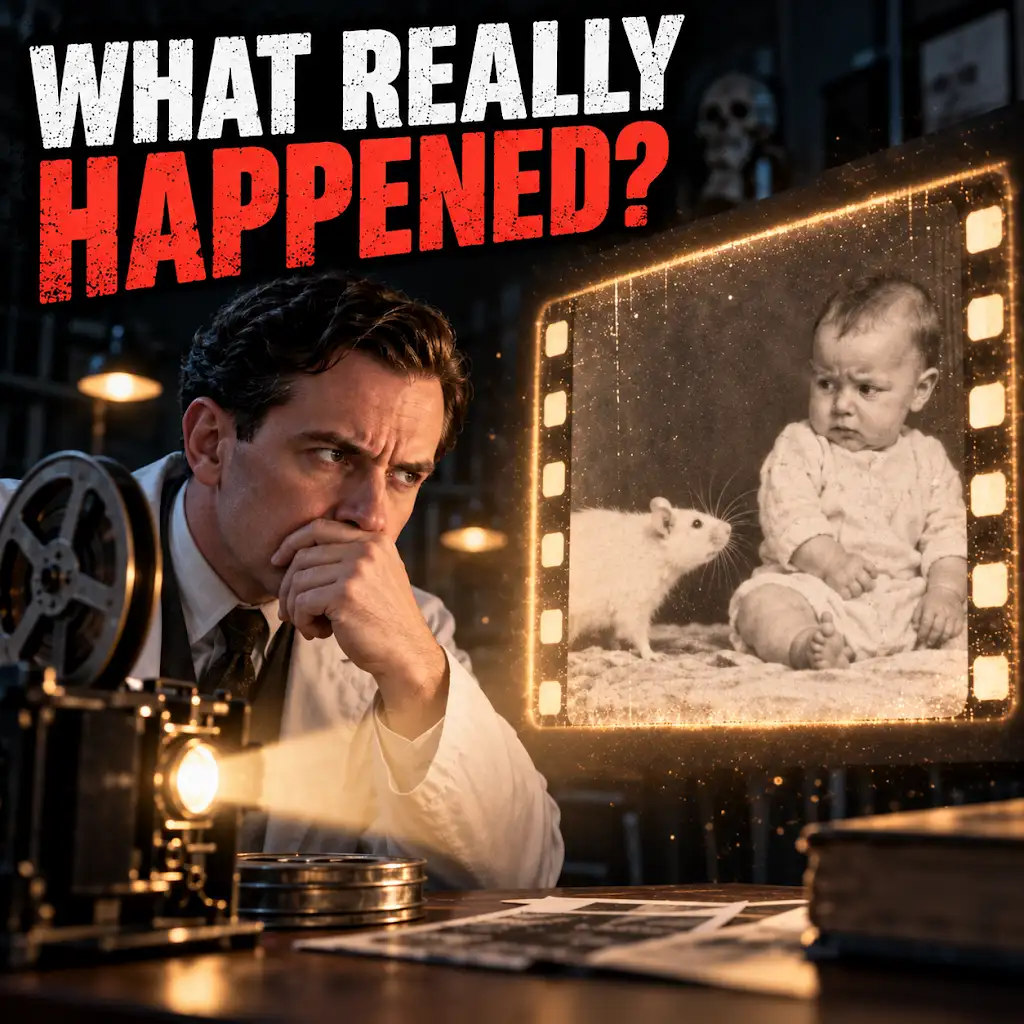
The neutral stimulus (NS) chosen for the experiment was a white rat. Initially, Albert showed no fear of the rat. He would reach for it, play with it, and interact with it in a seemingly positive manner. This lack of initial fear was critical, as it established the rat as a stimulus that did not naturally evoke a fear response, making it a suitable candidate for conditioning. The researchers systematically presented the rat to Albert on multiple occasions, observing his reactions closely.
The Conditioning Process: Pairing Stimuli

Stage 1: Baseline Observation
Before initiating the conditioning process, Watson and Rayner conducted baseline observations to establish Albert’s initial reactions to various stimuli. They presented him with a variety of objects, including a white rat, a rabbit, a dog, a monkey, masks with and without hair, cotton wool, and newspapers. As expected, Albert showed no fear of these items, interacting with them in a calm and curious manner. This baseline data was crucial for demonstrating that any subsequent fear response was indeed a result of the conditioning procedure and not a pre-existing condition.
Stage 2: The Unconditioned Response
The next step was to elicit the unconditioned response (UCR) – fear – using the unconditioned stimulus (UCS) – the loud noise. When the white rat was presented to Albert, and simultaneously the loud noise was produced, Albert reacted with immediate distress. He began to cry, flinch, and move away from the rat. This demonstrated that the loud noise was indeed a potent UCS that reliably produced a fear response in Albert. This pairing of the NS (rat) and the UCS (noise) was the core of the conditioning procedure.
Stage 3: Repeated Pairings and Generalization
The conditioning process involved repeatedly pairing the presentation of the white rat with the loud noise. This was done over several experimental sessions. With each pairing, Albert’s fear response towards the rat became more pronounced. What initially might have been a mild startle evolved into full-blown crying, fear, and attempts to escape. Crucially, the researchers observed a phenomenon known as generalization. Albert’s fear began to extend beyond just the white rat.
Generalization: A Broader Fearful Response
The researchers noted that Albert’s conditioned fear response was not limited solely to the white rat. After the conditioning, when presented with other furry objects, such as a rabbit, a fur coat, a dog, and even a Santa Claus mask with white whiskers, Albert displayed similar fear reactions. This indicated that the conditioned fear had generalized to stimuli that shared some characteristics with the original conditioned stimulus (the white rat), such as whiteness and furriness. This generalization was a key finding, suggesting that conditioned emotional responses could be more pervasive than initially anticipated.
The Results and Their Implications: A Powerful Demonstration

The Conditioned Fear Response
The experiment successfully demonstrated that Albert had developed a conditioned fear response to the white rat. The rat, which was initially a neutral stimulus, had become a conditioned stimulus (CS) capable of eliciting a conditioned fear response (CR) similar to the original unconditioned fear. This was evident in Albert’s vigorous crying, attempts to escape, and overall distress whenever the rat was presented, even without the accompanying loud noise.
The Principle of Classical Conditioning in Humans
The Watson and Rayner experiment provided one of the earliest and most compelling demonstrations of classical conditioning in humans. It showed that emotional responses, often considered complex and deeply rooted, could be shaped through simple associative learning. This challenged prevailing theories that emphasized innate biological predispositions for emotional responses.
The Ethical Controversy and Lasting Legacy
The ethical implications of the Watson and Rayner experiment continue to be debated. The deliberate infliction of fear on an infant, the lack of informed consent, and the potential for lasting psychological harm are significant concerns. While the experiment yielded valuable insights into the mechanisms of learning, it also served as a cautionary tale about the responsibilities of psychological researchers. Despite these ethical shortcomings, the experiment’s findings had a profound impact on the development of behaviorism, influencing therapeutic approaches like behavior modification and desensitization techniques.
The Watson and Rayner experiment, famously known for its exploration of classical conditioning through the Little Albert study, has sparked significant interest in the field of psychology. For those looking to delve deeper into the implications and methodologies of this groundbreaking research, a related article can provide valuable insights. You can explore more about the experiment and its impact on behavioral psychology by visiting this detailed resource. This article not only outlines the experiment’s design but also discusses its ethical considerations and lasting influence on psychological practices.
Unconditioning and Further Research: The Unanswered Questions
| Aspect | Details |
|---|---|
| Experiment Name | Watson and Rayner’s Little Albert Experiment |
| Year Conducted | 1920 |
| Researchers | John B. Watson and Rosalie Rayner |
| Subject | Little Albert (an infant) |
| Objective | To demonstrate classical conditioning in humans |
| Unconditioned Stimulus (UCS) | Loud noise (striking a metal bar) |
| Unconditioned Response (UCR) | Fear response (crying, distress) |
| Conditioned Stimulus (CS) | White rat |
| Conditioned Response (CR) | Fear response to white rat |
| Procedure | Pairing white rat with loud noise repeatedly to elicit fear |
| Results | Albert developed fear of white rat and generalized fear to other white furry objects |
| Significance | Provided evidence for classical conditioning in humans and emotional responses |
| Ethical Concerns | Lack of informed consent, distress caused to infant, no follow-up to remove fear |
The Lack of Deconditioning
A major ethical failing of the experiment was the departure of Albert’s mother before any attempt could be made to decondition his fear. Watson and Rayner had planned to uncondition Albert’s fear through exposure to the rat without the loud noise, or by pairing the rat with pleasant experiences. However, this crucial step was never performed. This left Albert with his conditioned fear, the long-term consequences of which remain unknown and a source of significant ethical concern.
Subsequent Studies and Methodological Critiques
The Watson and Rayner experiment inspired numerous subsequent studies on classical conditioning in humans, particularly in children. Researchers attempted to replicate and expand upon their findings, often with more ethical considerations. However, the original experiment has also faced methodological critiques regarding the small sample size, the subjective nature of some of the observations, and the lack of control over other environmental factors that might have influenced Albert’s behavior.
The Broader Impact on Psychology
Despite its ethical flaws, the Watson and Rayner experiment played a pivotal role in solidifying behaviorism as a dominant force in psychology. It provided empirical support for the idea that behavior is learned and can be modified through environmental influences. This had far-reaching consequences, leading to the development of various therapeutic interventions aimed at changing maladaptive behaviors and phobias. The experiment’s legacy, therefore, is a complex tapestry of scientific advancement and ethical debate, a testament to the enduring power of human curiosity and the critical importance of responsible research practices.
The Little Albert Experiment May Not Have Worked
FAQs
What was the Watson and Rayner experiment?
The Watson and Rayner experiment, also known as the Little Albert experiment, was a study conducted in 1920 by John B. Watson and Rosalie Rayner to demonstrate classical conditioning in humans.
Who were John B. Watson and Rosalie Rayner?
John B. Watson was an American psychologist known for founding the school of behaviorism, while Rosalie Rayner was his assistant and co-researcher on the Little Albert experiment.
What was the purpose of the Watson and Rayner experiment?
The purpose of the experiment was to show how emotions could be conditioned in a human subject through association with a neutral stimulus, following the principles of classical conditioning.
What were the key findings of the Watson and Rayner experiment?
The key finding of the experiment was that Little Albert, the infant subject, developed a fear response to a white rat after associating it with a loud noise, demonstrating classical conditioning in humans.
What ethical concerns were raised regarding the Watson and Rayner experiment?
The experiment raised ethical concerns due to the emotional distress caused to Little Albert, the lack of informed consent, and the potential long-term psychological effects on the subject.