The hushed whispers of scientific curiosity have long echoed through the annals of psychology, some leading to profound insights, others to deeply troubling ethical quandaries. Among the latter, the Little Albert experiment stands as a stark reminder of a darker era of psychological inquiry, an era where the pursuit of knowledge sometimes overshadowed the well-being of the subject. For decades, the experiment’s findings have been discussed, debated, and dissected, yet the actual visual record of these events remained elusive, confined to faded descriptions and historical accounts. Until now.
The recent, astonishing discovery of surviving footage from the Little Albert experiment has sent ripples of shock and fascination through the academic and historical communities. This visual material, long believed lost to the ravages of time and institutional indifference, offers an unprecedented, and frankly disturbing, window into one of psychology’s most controversial studies. It transforms abstract descriptions into visceral realities, forcing a re-evaluation of not only the experiment itself but also the ethical landscape of early psychological research.
John B. Watson, a pioneering figure in psychology, was a fervent advocate for behaviorism, a school of thought that posited that human behavior could be understood and predicted solely by observing external stimuli and responses, dismissing the influence of internal mental states. Watson’s ambition was to demonstrate that emotions, far from being innate or inexplicable, could be conditioned, much like a reflex. He sought to prove that fear, a fundamental human emotion, could be instilled in an individual through systematic association. His target: the infant he famously dubbed “Little Albert.”
Watson’s Theoretical Framework and the Promise of Control
Watson’s theoretical underpinnings were deeply rooted in the principles of classical conditioning, famously elucidated by Ivan Pavlov’s experiments with dogs. Pavlov had shown how a neutral stimulus (the sound of a bell) could, through repeated association with an unconditioned stimulus (food), elicit a conditioned response (salivation). Watson believed this same principle could be applied to human emotional responses. His vision was one of psychological control, where understanding the mechanisms of behavior would allow for its manipulation and, he argued, its improvement. The Little Albert experiment was intended as the ultimate proof of concept, a dramatic demonstration of the power of conditioned fear.
The Laboratory Setting: A Stage for Experimentation
The experiments were conducted at the Johns Hopkins Hospital in Baltimore, a setting that lent an air of legitimacy to Watson’s work. However, the very nature of the experiment inherently placed the infant in an environment far removed from a typical nurturing setting. The laboratory, with its controlled conditions and the presence of researchers and equipment, would have been alien and potentially unsettling for a young child. The footage, when it emerged, would illuminate the stark reality of this controlled environment.
The Little Albert experiment, a pivotal study in psychology conducted by John B. Watson and Rosalie Rayner, has long intrigued researchers and the public alike, particularly with the recent interest in surviving footage that sheds light on the experiment’s methodology and ethical implications. For those looking to delve deeper into this fascinating topic, a related article can be found at Unplugged Psych, which explores the historical context and the lasting impact of the experiment on the field of psychology.
The Unfolding Nightmare: Documenting Little Albert’s Conditioning
The surviving footage, though grainy and silent, captures the progression of Watson’s experiment with chilling clarity. Viewers are confronted with the initial interactions between the infant and the researchers, followed by the systematic introduction of stimuli designed to evoke fear. The ethical boundaries, so clearly defined in modern research, were demonstrably crossed.
The Neutral Stimulus: Albert’s Initial Curiosity
The early segments of the footage show Little Albert, an infant of approximately nine months, interacting with a variety of neutral stimuli. He is presented with a white rat, a rabbit, a monkey, and even a mask with spectacles. In these initial scenes, Albert displays curiosity, reaching out to touch and explore these objects. There is no overt sign of fear. This baseline behavior is crucial for understanding the subsequent conditioning. The footage allows for a direct comparison of Albert’s reactions before and after the introduction of the fear-inducing element.
The Unconditioned Stimulus: The Terrifying Sound
The pivotal moment, meticulously documented in the film, is the introduction of the unconditioned stimulus: a loud, jarring noise. This was achieved by Watson striking a steel bar with a hammer behind Albert’s head. The footage captures Albert’s immediate and profound reaction to this sound. He cries, whimpers, and recoils in terror. The sheer suddenness and intensity of the sound are palpable, even without accompanying audio. The visual evidence starkly illustrates the power of this aversive stimulus to elicit a strong, unconditioned fear response.
The Conditioning Process: Pairing the Rat and the Noise
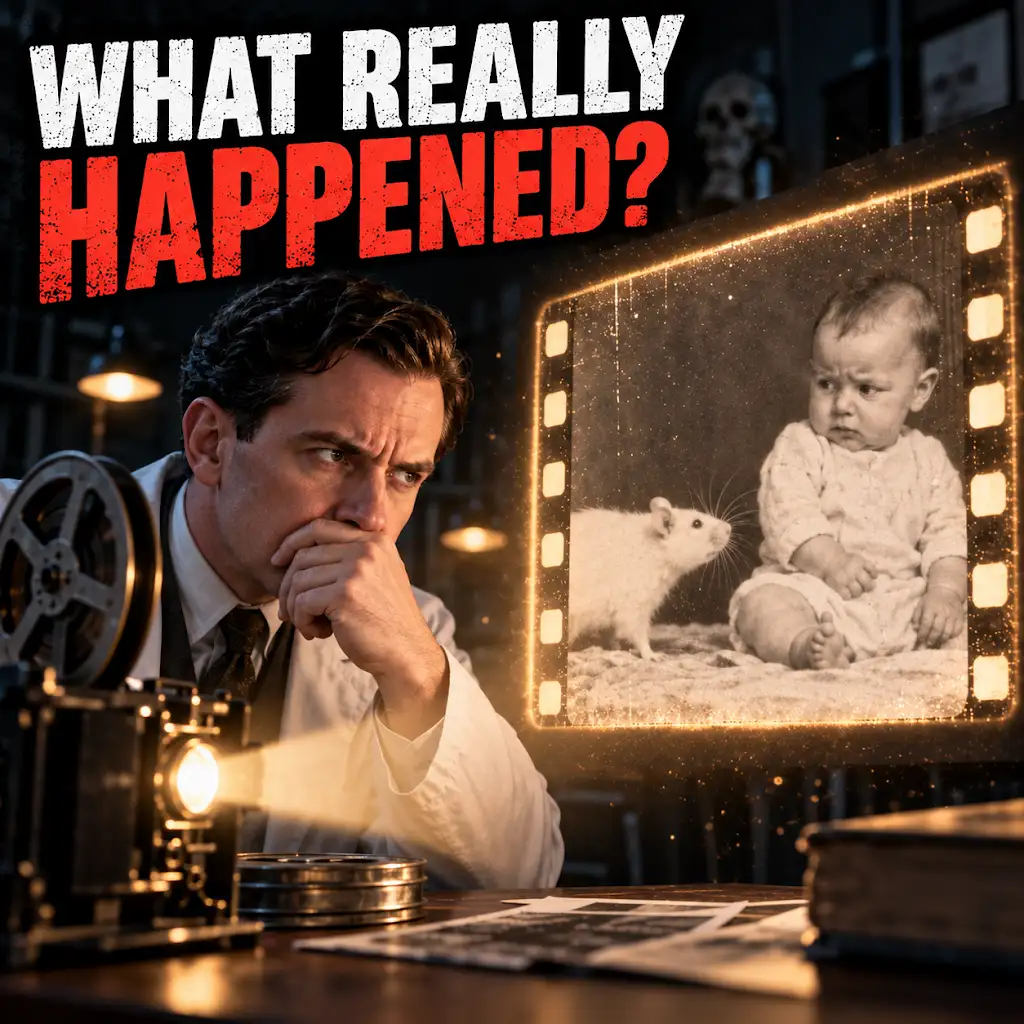
The core of the experiment involved the repeated pairing of the white rat (the neutral stimulus) with the loud noise (the unconditioned stimulus). The footage shows the researchers presenting the rat to Albert, and just as he reaches for it, the hammer strikes the steel bar, eliciting the frightening sound. This process is repeated multiple times. The visual narrative unfolds with a disturbing inevitability, as Albert’s initial curiosity towards the rat begins to transform into apprehension and, eventually, outright fear. The footage captures the subtle shifts in his body language, the widening of his eyes, the tensing of his limbs, and the beginnings of distress even before the sound is produced.
The Trajectory of Fear: Little Albert’s Conditioned Responses

The conditioning appears to have been remarkably swift and effective, at least within the parameters of the experiment. The footage documents the development of Albert’s conditioned fear response to the white rat. What was once a source of innocent exploration quickly became an object of profound dread.
Generalization of Fear: Beyond the White Rat
One of the most significant, and ethically troubling, aspects of the experiment was the apparent generalization of Albert’s fear. The footage reveals that after being conditioned to fear the white rat, Albert began to exhibit fear responses to other furry objects. He was presented with a rabbit, a dog, and even a fur coat, all of which elicited the same distress and crying as the original conditioned stimulus. This demonstrated that the conditioned fear was not limited to the specific stimulus used in training but could extend to similar objects, a phenomenon known as stimulus generalization. The visual evidence of Albert recoiling from these new, yet similar, stimuli is deeply unsettling.
The Absence of Deconditioning: An Unresolved Trauma
Crucially, the surviving footage provides no evidence of any attempt to decondition Little Albert. The experiment appears to have concluded with Albert in a state of heightened fear and anxiety. There are no scenes depicting Watson or his colleagues attempting to reverse the learned fear response, to reintroduce the stimuli in a non-threatening manner, or to comfort the distressed child. This omission is a significant ethical failing, leaving the lasting impact of the experiment on Albert tragically unresolved within the visual record. The footage ends with Albert exhibiting fear, a stark testament to the psychological toll of the study.
The Ethical Minefield: Critiques and Repercussions of the Experiment

The Little Albert experiment has been a lightning rod for ethical criticism since its inception. The discovery of the footage has only amplified these concerns, providing irrefutable visual evidence of the ethical breaches.
Exploitation of an Innocent: The Vulnerability of an Infant
The most potent ethical critique centers on the exploitation of a vulnerable infant. Albert was a child, incapable of providing informed consent, and seemingly unaware of the full implications of the procedures being inflicted upon him. The footage visually underscores his helplessness and his susceptibility to the researchers’ manipulations. The experiment treats Albert not as an individual with rights and feelings, but as a tool to prove a theoretical point. The innocence of his early interactions contrasted with his later terror makes for profoundly disturbing viewing.
The Lack of Consent and the Unforeseen Consequences
There is no evidence that Albert’s mother, or any guardian, provided fully informed consent for the experiment. While some accounts suggest she may have been a nurse at the hospital, the extent to which she understood the nature of the conditioning and its potential long-term effects is highly questionable. The footage highlights the devastating and unforeseen consequences of this lack of consent, as Albert is left with a seemingly permanent phobia. The ethical implications of conducting such an experiment without full and informed consent are immense, especially when the subject is a defenseless child.
The Lasting Legacy of a Questionable Study
The Little Albert experiment, despite its ethical failings, did contribute to the understanding of classical conditioning and its application to human behavior. However, its legacy is irrevocably tainted by the manner in which it was conducted. The visual evidence from the surviving footage serves as a powerful reminder of the need for strict ethical guidelines in psychological research, and the importance of prioritizing the well-being of participants above all else. The experiment has become a cautionary tale, a symbol of how scientific ambition, unchecked by ethical considerations, can lead to profound harm.
The Little Albert experiment, a pivotal study in psychology, has sparked interest not only for its controversial methods but also for the ethical implications it raises. Recently, there has been a fascinating discussion surrounding the surviving footage related to this experiment, which sheds light on the emotional responses elicited in the young subject. For those interested in exploring this topic further, you can read more about it in a related article on the Unplugged Psychology website. This resource provides an in-depth analysis of the experiment’s impact on behavioral psychology and its lasting legacy. To access the article, click here: Unplugged Psychology.
The Unanswered Questions and the Future of Psychological Ethics
| Metric | Details |
|---|---|
| Experiment Date | 1920 |
| Researcher | John B. Watson and Rosalie Rayner |
| Subject | Little Albert (infant male) |
| Type of Experiment | Classical Conditioning (Fear Conditioning) |
| Surviving Footage Availability | No known surviving video footage exists |
| Documentation | Written reports and photographs only |
| Ethical Concerns | High; experiment considered unethical by modern standards |
| Impact on Psychology | Significant; demonstrated conditioned emotional responses |
The unearthing of this footage has not only provided a chilling visual record but has also reignited crucial debates about the study’s specifics and its place in modern psychology.
The Identity and Fate of Little Albert: A Persistent Mystery
Despite extensive research, the true identity of Little Albert remains a subject of ongoing debate. While several individuals have been proposed as candidates, definitive proof has been elusive. The surviving footage, while offering a window into his experience, does not provide the clues needed to definitively identify him. The question of what became of Little Albert after the experiment is one that continues to haunt researchers and ethicists alike. Did he live a life free from the conditioned fears? Was he ever deconditioned? The footage offers no answers, leaving a void of profound concern.
Re-evaluating Behaviorism in the Light of New Evidence
The visual evidence of Little Albert’s distress and the seemingly unaddressed trauma raises important questions about the practical application and ethical boundaries of strict behaviorist principles. While behaviorism has undeniably advanced our understanding of learning, the footage forces a re-evaluation of its potential downsides when applied without sufficient regard for the subject’s emotional and psychological state. The footage demonstrates that observable behavior does not tell the whole story, and that internal distress, even if not explicitly stated, is a critical factor to consider.
Towards a More Ethical Future: Lessons Learned and Safeguards Implemented
The Little Albert experiment, with all its inherent ethical flaws, has served as a crucial, albeit painful, lesson for the field of psychology. The discovery of this footage reinforces the importance of robust ethical review boards, informed consent procedures, and the paramount principle of “do no harm.” Modern psychological research is governed by stringent ethical codes that were, in part, a direct response to the controversies surrounding studies like Little Albert. The visual record of this experiment acts as a stark, permanent reminder of the progress made and the vigilance required to ensure that scientific advancement never again comes at such a profound cost to human dignity. The footage is not just historical artifact; it is a call to continued ethical reflection and unwavering commitment to participant welfare.
The Little Albert Experiment May Not Have Worked
FAQs
What is the Little Albert experiment?
The Little Albert experiment was a controversial psychology experiment conducted by John B. Watson and Rosalie Rayner in 1920. It involved conditioning a young boy, known as “Little Albert,” to fear a white rat by pairing its presence with a loud, startling noise.
Is there surviving footage of the Little Albert experiment?
No, there is no surviving footage of the Little Albert experiment. The original film recordings of the experiment have been lost over time, and no known footage exists.
What were the ethical concerns surrounding the Little Albert experiment?
The Little Albert experiment raised significant ethical concerns due to the lack of informed consent, the potential for causing psychological harm to the child, and the lack of debriefing after the experiment. These ethical issues have led to criticism of the study.
What were the long-term effects on Little Albert after the experiment?
The long-term effects on Little Albert after the experiment are not well-documented. It is believed that his real identity and fate remain unknown, as his identity was never revealed in the published study.
What was the significance of the Little Albert experiment in the field of psychology?
The Little Albert experiment is considered a landmark study in the field of psychology as it demonstrated the principles of classical conditioning and the potential for creating phobias through conditioning. The study has had a lasting impact on the understanding of behaviorism and ethical considerations in research.